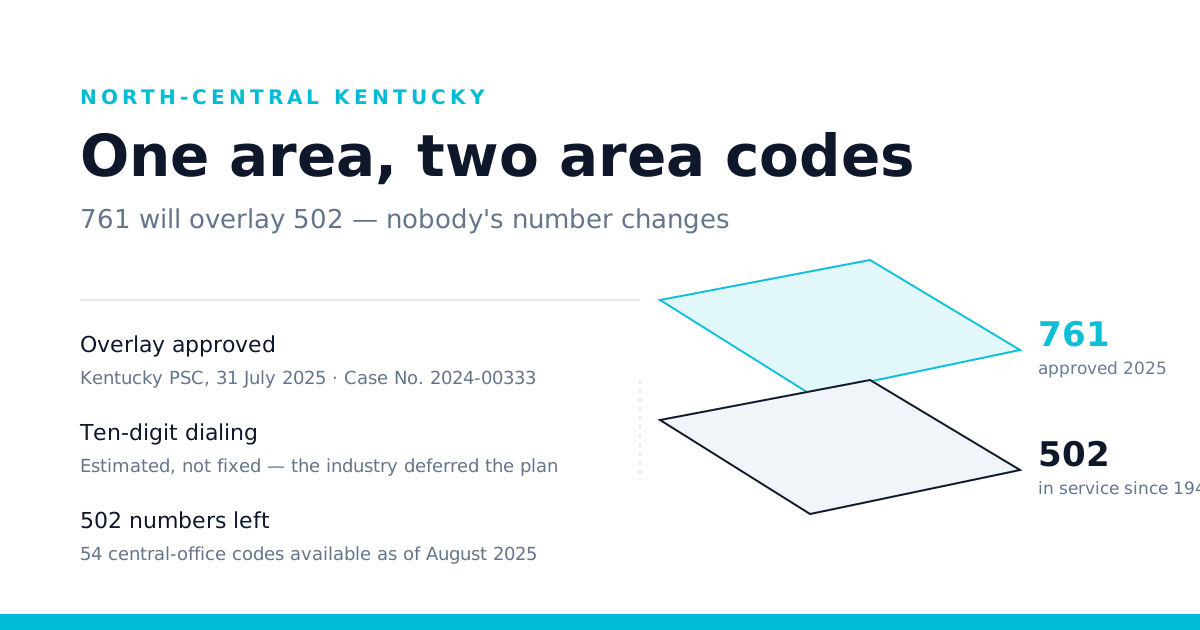
Where does 502 cover?
The Kentucky Public Service Commission describes the 502 area as north-central Kentucky, with Louisville as its largest city. Frankfort is inside it too, which is easy to confirm from the Commission's own letterhead: the PSC answers on (502) 564-3940.
Beyond that, be careful with city lists. The PSC's notice does not enumerate the towns in the area, and the boundary is drawn by rate centers rather than by county lines, so the lists you will find on other sites are reconstructions rather than an official register. Shelbyville, Bardstown and Elizabethtown are commonly described as 502; treat that as likely rather than confirmed unless your carrier tells you otherwise. What is on the record is the code's reach in the other direction — 502 is one of the original 1947 area codes and once served the whole state.
An area code says where a number was issued, not where its holder is. A Louisville mobile keeps 502 after a move to Nashville, and caller ID can be set to a number the caller has no connection to, which the FCC calls spoofing. Read 502 as "numbered in north-central Kentucky", nothing stronger.
What is the 761 area code?
761 is the new code approved for the same area 502 already covers. It is an all-services distributed overlay: a second code laid over the same map so new lines can be numbered once 502 runs short. The Commission ordered it on 31 July 2025 in Case No. 2024-00333, and NANPA's area code database records 761 as assigned on 7 August 2025 with no in-service date.
Nobody's number changes. That was the reason for choosing an overlay at all: the alternative, a geographic split, forces one group of customers onto a new code, and Kentucky has already been split twice in the last 30 years — 270 was carved out of 502 for western Kentucky in 1999. The price of not splitting is that everyone in the area eventually dials ten digits.
| 502 | 761 | |
|---|---|---|
| Status | In service since 1 January 1947 | Assigned 7 August 2025, not in service |
| Area covered | The same — north-central Kentucky, including Louisville and Frankfort | |
| Who holds one | Every number in the area today | New lines, once 502 prefixes are used up |
| Local dialing | Seven digits today | Ten digits, for both codes, once 761 starts |
| Expected life | 761 is projected to last about 30 years once it begins | |
"Distributed" is the part with practical consequences. It means 761 numbers will be handed out across the whole area rather than reserved for one city, so once the overlay starts, two businesses on the same street can hold different codes — and neither code will tell you anything about which part of the region a line belongs to.
When does ten-digit dialing start?
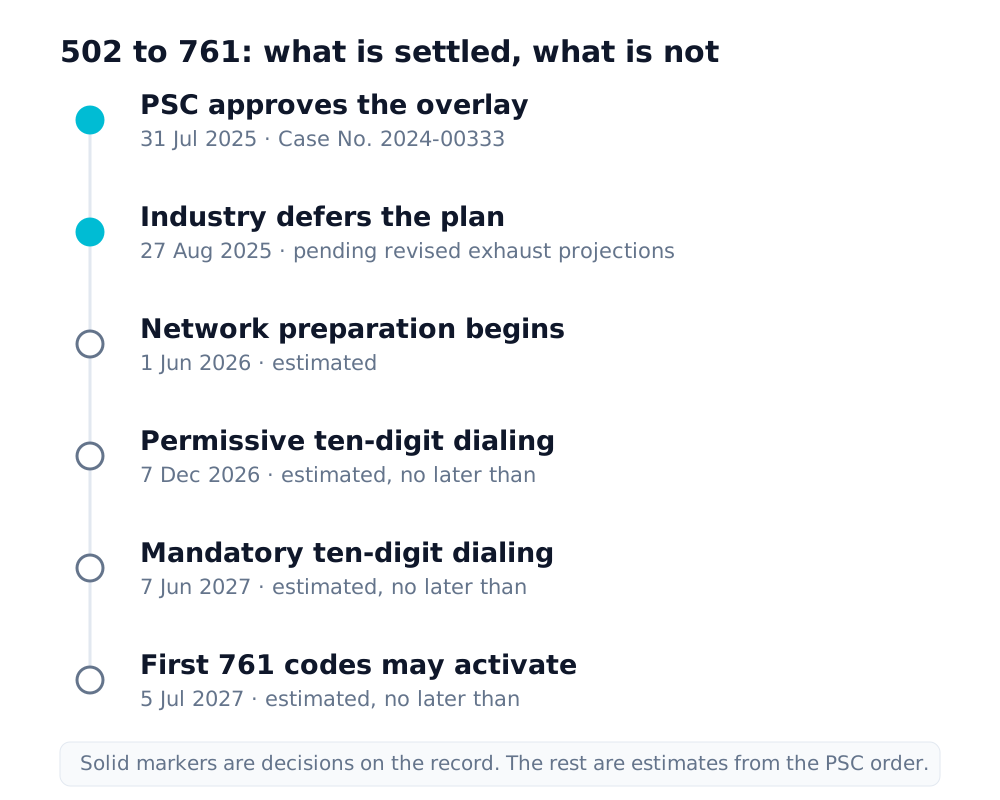
No date has been fixed. Today, a local call inside 502 is still seven digits, which NANPA's database confirms: 502's home-area local calls are recorded as 7D. The PSC's order contains a schedule, but every line of it is written as an estimate.
| Stage | Former estimated date (suspended) | What it means |
|---|---|---|
| Network preparation | From 1 June 2026 | Carriers make their switches ready. Nothing visible to customers |
| Permissive ten-digit dialing | No later than 7 December 2026 | Seven and ten digits both work. The period for fixing dial plans |
| Mandatory ten-digit dialing | No later than 7 June 2027 | Seven-digit local calls stop completing |
| First 761 numbers | No later than 5 July 2027 | Earliest date a 761 prefix may be activated |
Those are the figures in NANPA's September 2025 filing in the case, and each one carries the word "estimated" in the order itself. The sites publishing them as fixed dates are quoting a plan the industry had already deferred by the time they wrote it.
Why the dates are still estimates
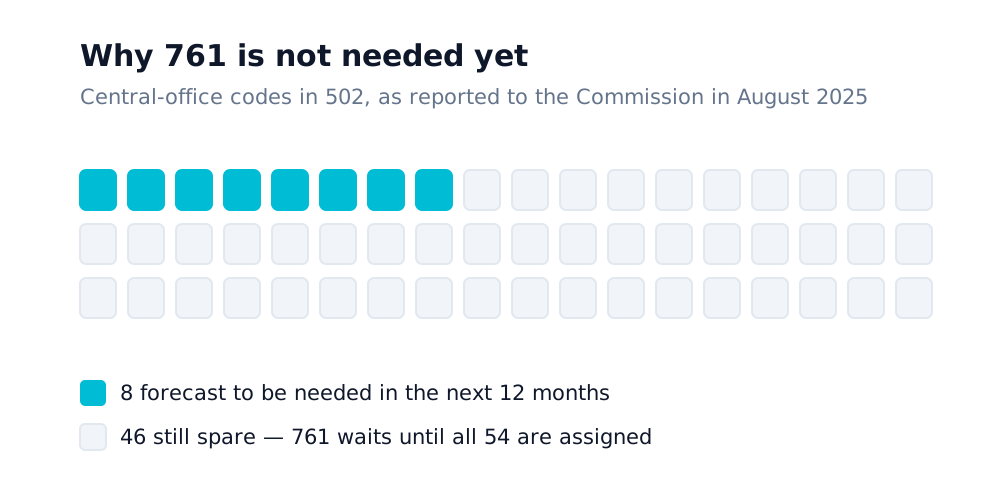
At the implementation meeting on 27 August 2025, the industry reached consensus to defer finalising a plan until NANPA published updated exhaust projections. The arithmetic behind that is the interesting part: about eight central-office codes were forecast as needed over the following twelve months, with 54 still available in 502.
At that rate the code has years of headroom, which is why the exhaust date was expected to move. The PSC's announcement cited a NANPA projection of the third quarter of 2027, and industry guidelines require an overlay to be in place at least six months before exhaust — that six-month rule, working backwards from a projection that keeps sliding, is what generated the 2026 and 2027 dates in the first place.
NANPA's database backs that up as of today's file. 502's relief status is recorded as "Trigger" — relief planning in progress, waiting on a threshold rather than running to a calendar — and 761 still has no in-service date. The PSC said plainly in August 2025 that a specific date for the introduction of 761 had not been set, and a year later that is still the case.
Update: in its January 2026 order the Kentucky PSC suspended the schedule above, because NANPA's projected exhaust date for 502 moved from the third quarter of 2027 to the second quarter of 2028. Its 23 June 2026 order kept the schedule suspended after NANPA moved the date again, to the first quarter of 2029, and requires a new proposed schedule when 502 is within 22 months of projected exhaust. The dates in the table are historical; check the case docket (2024-00333) for later filings.
What this means if you are planning around it: do not book a cutover against December 2026 or June 2027. Watch for the industry to publish a new schedule, then work back from the permissive-dialing date — which is the window when both formats work and you can change dial plans without breaking calls.
What ten-digit dialing breaks
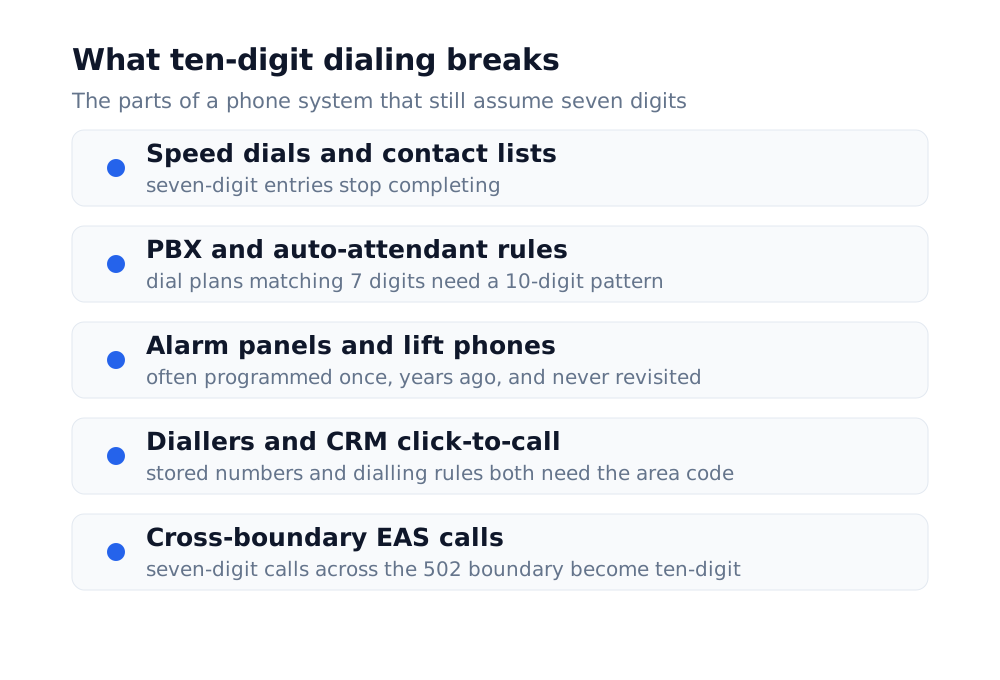
When the change does come, the handsets are the easy part. The failures land in the places where seven digits were written down once and never revisited.
Dial plans and auto-attendants
A PBX rule that matches seven digits and routes the call needs a ten-digit pattern beside it. Most systems accept both formats at once, which is what makes the permissive period usable: you add the new pattern, leave the old one in place, and remove it after the cutover rather than during it.
Alarm panels, lift phones and fax lines
Programmed once, often by a contractor who has since moved on. These are the calls that fail silently, because nobody tests them until they are needed. A building with a monitored alarm on a seven-digit dial string is the clearest argument for doing the inventory early.
Stored numbers and click-to-call
Speed dials, contact lists and CRM records holding seven digits stop completing. Reformatting a customer database to ten digits is not difficult, but click-to-call adds a second problem: the dialling rules in the softphone or browser extension have to agree with the new format, and those are often configured separately from the phone system.
Cross-boundary calls under extended area service
The order is specific here: existing arrangements that allow seven-digit dialing across the 502 boundary under extended area service must convert to ten digits. This is not hypothetical — 606 in eastern Kentucky still carries seven-digit cross-boundary dialing on the NANPA record. If your site sits near the edge of the area and staff dial a neighbouring exchange with seven digits today, that habit is on the list too.
Test calls, not assumptions
One limitation worth stating plainly: no vendor list will tell you which of your own dial strings are seven digits. The only reliable method is to place test calls from each system that dials out — desk phones, the auto-attendant, the alarm panel, the dialler — during the permissive period, when a wrong format still connects.
The practical approach is to inventory the seven-digit entries now, while there is no deadline pressing, rather than during a permissive window whose start date nobody can yet name. Our guide to how area codes affect call routing and dial plans covers what to check; teams moving a Louisville office onto cloud calling can handle the dialing rules centrally with MCC Business Phone.
Can you still get a 502 number?
Yes — and right now, only a 502 number. 761 is assigned but not in service, so every new line issued in north-central Kentucky today carries 502. That is unusual: in most overlay areas, such as Oakland's 510 and 341, a new number could arrive with either code.
Supply is not tight either. The 54 codes available in August 2025, against demand of roughly eight a year, is a comfortable margin by the standards of a metro area. What the forecast cannot tell you is which prefixes your carrier holds — numbers come out of a carrier's own inventory, so availability of a specific Louisville prefix is a question for the carrier rather than for NANPA.
When 761 does arrive, the distributed overlay means new customers will get whichever code their carrier can draw from, with no geographic logic to it, and whether a 502 number is available depends on your provider's inventory. If a 502 number matters to your business identity, the numbers you hold now are the ones that will carry it.
502 caller ID, spoofing and spam labels
A 502 number on a screen tells you where the number was issued. It is not proof of who is calling: caller ID can be set to a number the caller has no connection to, which the FCC calls spoofing. Numbers from the capital region get used that way because a local, official-looking code is answered more often than an unknown one.
For a business dialling out from a 502 number, two separate mechanisms decide what the called party sees. The first is whether your calling number survives the carriers between you and the handset. The second is how the terminating network scores the call — short duration, high volume from a single number and low answer rates all feed the analytics that attach a warning label. A label that sticks to a number does not clear because you changed supplier, and rotating to a fresh number restarts the same process rather than ending it.
Both are route questions rather than dial-plan questions, and the overlay changes neither. CLI vs NCLI routes covers what decides whether your number arrives intact; buying USA CC routes covers the US-specific part for outbound campaigns.
Which area codes border 502?
Kentucky uses four area codes today, and Louisville sits on the Indiana state line, so the area also borders two Indiana codes across the Ohio River. In-service dates below are from NANPA's area code database.
| Code | Direction | Area, and how it relates to 502 |
|---|---|---|
| 270 | West and south-west | Western Kentucky, including Bowling Green and Paducah. Split from 502 in April 1999, now overlaid by 364 (March 2014) — so that region already dials ten digits |
| 859 | East | Lexington and northern Kentucky. Split from 606 in April 2000 |
| 606 | Further east | Eastern Kentucky, in service since 1955. Still seven-digit local dialing, with some cross-boundary seven-digit arrangements |
| 812 / 930 | North, across the Ohio | Southern Indiana, including Jeffersonville and New Albany. 812 dates to 1947; 930 overlaid it in March 2015 |
Two of Kentucky's own codes are on ten-digit dialing already, and both Indiana codes across the river are too. When 502 changes, it will be the last major part of the state to do it. Other US codes are collected in our area code guides, including 202 (Washington D.C.), 469 (Dallas) and 720 (Denver).
502 area code FAQ
What city is area code 502?
Louisville is the largest city in the 502 area, which the Kentucky PSC describes as north-central Kentucky. Frankfort, the state capital, is in it too — the Commission itself answers on a 502 number.
Is my 502 number changing to 761?
No. 761 is an overlay, added over the same area rather than replacing anything, so existing 502 numbers keep their code. 761 will only go to new lines once 502 prefixes run out.
When does ten-digit dialing start in the 502 area code?
No date is currently in force. The PSC's July 2025 order estimated permissive ten-digit dialing by 7 December 2026 and mandatory dialing by 7 June 2027, but its January 2026 order suspended that schedule after NANPA moved the projected 502 exhaust date to the second quarter of 2028, and a June 2026 order kept it suspended after the date moved again to the first quarter of 2029. A new proposed schedule is due when 502 is within 22 months of projected exhaust.
Can you still get a 502 phone number?
Yes. 761 is assigned but not in service, so every new number issued in the area today is a 502 number. About 54 central-office codes were available in August 2025 against demand of roughly eight a year.
Why an overlay instead of splitting 502?
A split forces one group of customers onto a new number, and Kentucky has been split twice in the last 30 years. The overlay changes nobody's number, at the cost of ten-digit dialing for everyone in the area.
Sources
- Kentucky Public Service Commission — New area code coming to north-central Kentucky (press release, 19 August 2025)
- NANPA — 502 overlay implementation filing, Case No. 2024-00333 (16 September 2025), including the Commission's order of 31 July 2025
- NANPA — Area code (NPA) database: in-service dates, relief status and dialing plans
- FCC — Caller ID spoofing
Planning a Louisville office move or a ten-digit dial-plan change?
My Call Connect Business Phone is a cloud phone system for teams. See what it includes and talk to us about your setup.